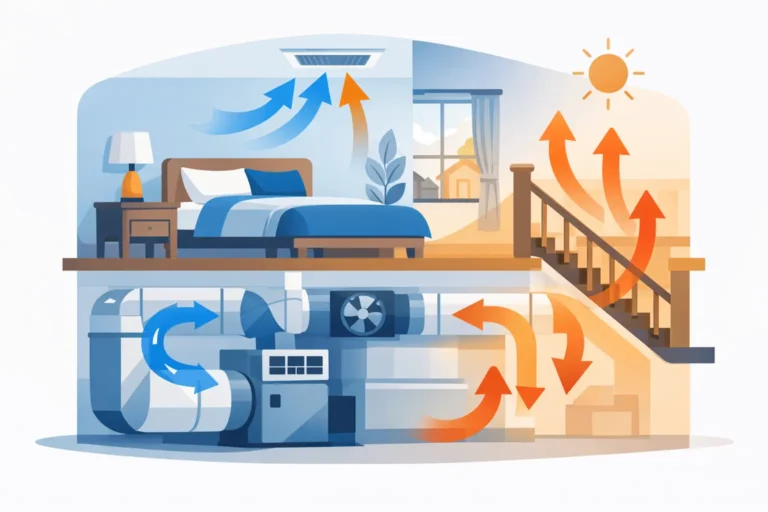

A second floor that stays warm while the downstairs feels comfortable is more than a minor annoyance in a Florida summer. It can lead to restless nights, a thermostat that gets lowered again and again, and an air conditioner that runs longer without delivering the comfort you expect. To improve upstairs HVAC airflow, start by separating simple airflow restrictions from system design or equipment issues. The right fix depends on why the air is not reaching the rooms that need it.
Why upstairs rooms often feel hotter
Heat naturally rises, but that is only part of the problem. Upstairs rooms are often closer to a hot attic, exposed to more direct sunlight, and affected by heat entering through the roof, windows, and uninsulated wall areas. In Tampa Bay homes, attic temperatures and high outdoor humidity can put significant pressure on the cooling system.
Your HVAC system also has to push conditioned air farther to reach many second-floor rooms. If duct runs are long, undersized, poorly insulated, disconnected, or leaking, airflow may weaken before it reaches the upstairs supply vents. Return-air pathways matter just as much. A closed bedroom door with no adequate return path can trap air in the room and make it harder for cool air to enter.
Sometimes the issue is not limited to the upstairs at all. A dirty filter, blower problem, frozen evaporator coil, or failing thermostat can reduce airflow throughout the house. The upstairs simply reveals the problem first because it has the highest cooling demand.
Start with the airflow checks homeowners can handle
A few basic checks can rule out common restrictions before assuming you need new equipment. Begin with the air filter. A filter loaded with dust, pet hair, or construction debris restricts the air entering the system. Check it monthly during heavy cooling season and replace it according to the manufacturer’s recommendation or sooner if it looks dirty.
Next, make sure all supply registers upstairs are fully open and unobstructed. Furniture, curtains, rugs, and stored belongings can block the air stream. Vacuum dust from the register faces, but do not try to reach deep into ductwork with household tools. A blocked or damaged register boot may need professional attention.
Check the return grilles as well. Return vents pull indoor air back to the air handler, where it can be cooled and sent out again. Keep these grilles clear of furniture and avoid covering them with decorative panels. If an upstairs bedroom becomes noticeably warmer when the door is closed, try leaving the door open for a day or two. That can point to an inadequate return-air path rather than a supply-vent problem.
Thermostat settings deserve a quick review. Set the fan to Auto for normal operation. Leaving it set to On can help mix air between cycles in some homes, but it can also circulate warmer, more humid air after the cooling cycle ends. In Florida, that humidity trade-off is worth considering.
Look for clues around the air handler
If airflow at multiple vents feels weak, listen for unusual sounds from the indoor unit. A whistling noise can indicate restricted airflow. Ice on the refrigerant line, water around the air handler, or a system that runs continuously without cooling properly should be addressed promptly. Continuing to operate a system with a frozen coil can lead to further damage and does not solve the airflow problem.
Avoid fixes that create bigger HVAC problems
It is tempting to close downstairs vents to force more air upstairs. In most homes, that approach does not work as expected. Central HVAC systems are designed around a specific amount of airflow and duct pressure. Closing several registers can increase static pressure, make the blower work harder, create noise, and potentially reduce overall system performance.
Portable fans can help make an uncomfortable room feel better, especially if they move air toward a hallway or return grille. They are useful for short-term comfort, but they do not correct a duct, insulation, or equipment issue. Likewise, turning the thermostat far below your normal setting will not make the system cool faster. It usually just makes the unit run longer.
Do not tape, crush, or reroute flexible ducts in an attic without understanding the layout. Flexible duct can kink easily, and poorly sealed connections allow conditioned air to escape into an extremely hot attic. What looks like a small do-it-yourself adjustment can reduce airflow even further.
Professional ways to improve upstairs HVAC airflow
When routine checks do not change the comfort level, a technician should diagnose the entire air-distribution system rather than guessing at a single repair. At Air Hawk Heating and Cooling, that means looking beyond the thermostat to evaluate airflow, duct condition, return capacity, refrigerant performance, and the equipment’s ability to meet the home’s cooling load.
Duct repair, sealing, and insulation
Leaky ducts are a frequent source of upstairs comfort problems. Conditioned air can escape through loose connections, torn flex duct, or gaps around duct boots before it reaches the room. Attic ducts also need proper insulation to protect cool air from surrounding heat.
Duct sealing and repair can restore delivery to distant rooms without changing the entire HVAC system. If ducts are undersized or poorly routed, however, sealing alone may not provide enough improvement. In that case, selective duct modifications or added return capacity may be the more durable solution.
Air balancing and return-air improvements
An HVAC technician can measure airflow at supply vents and assess pressure within the duct system. This process, often called air balancing, helps identify whether too much air is serving one area while another area is being starved.
Balancing may involve adjusting dampers, not simply closing registers. Dampers are installed in duct branches and allow controlled changes to airflow distribution. Some homes also benefit from an additional return grille, a transfer grille, or another approved return-air solution upstairs. The best option depends on the home’s layout, bedroom-door use, and existing duct design.
Equipment and blower performance
A dirty evaporator coil, weak blower motor, incorrect blower settings, or refrigerant issue can all affect airflow and cooling. These are not conditions to diagnose by vent temperature alone. A thorough service visit includes checking the system’s operating conditions and confirming that the air handler is moving the volume of air the equipment requires.
If the system is older, oversized, undersized, or poorly matched to the ductwork, replacement may eventually be worth discussing. That does not mean every hot upstairs room requires a new air conditioner. A properly performed load calculation, duct evaluation, and review of insulation levels should come before a major recommendation.
Consider zoning or ductless cooling for persistent hot areas
For a consistently warm second floor, a zoning system can offer more control by using separate thermostats and motorized dampers to direct cooling where it is needed. Zoning works best when the equipment, ducts, and controls are designed to support it. Adding dampers without accounting for airflow requirements can create the same pressure issues caused by closing too many vents.
A ductless mini-split is another practical option for an upstairs addition, bonus room, converted attic, or area with stubborn cooling demand. It provides independent temperature control without requiring a major duct extension. The trade-off is the added indoor unit and the need for professional sizing and placement.
Before investing in either solution, inspect attic insulation and air sealing. If the second floor is gaining excessive heat through the attic or sun-facing windows, HVAC upgrades alone may have to work harder than necessary. Improving the building envelope can reduce the cooling load and make any airflow correction more effective.
A comfortable upstairs should not require keeping the thermostat unreasonably low or accepting weak airflow as normal. Pay attention to when the problem occurs, whether it affects one room or the whole floor, and whether closed doors make it worse. Those details give a qualified HVAC technician a much clearer path to the right repair and a home that stays comfortable through the hottest Pasco County afternoons.